


The short answer
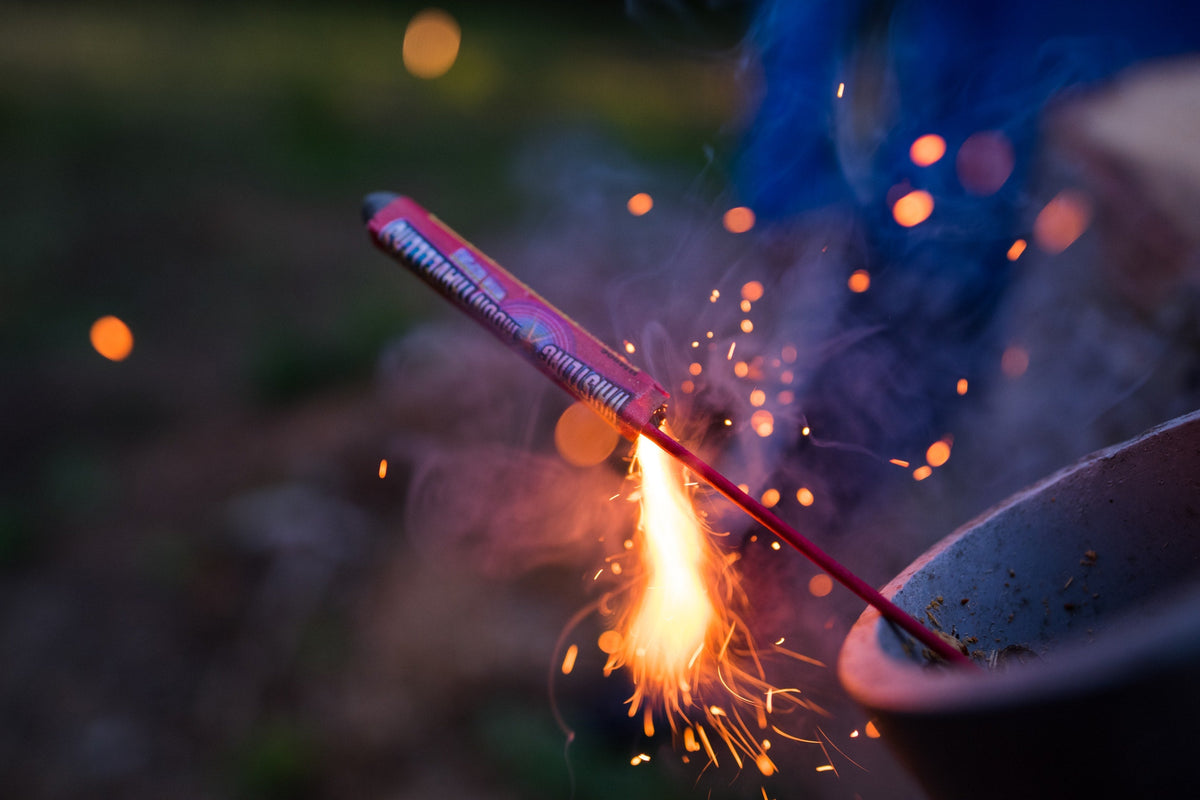
The fireworks ban in the Netherlands came into force on 1 August 2026. From that moment on, as a consumer you may no longer buy or set off consumer fireworks. New Year 2026 into 2027 is the first one it applies to. What you may still set off is F1 fireworks: sparklers, party poppers, snap pops and small ornamental fountains, from the age of twelve and all year round.
In practice it comes down to this: no more cakes, fountains or ground spinners in the front garden. For the light F1 stuff that remains you need nothing special. And you can keep your lighter. A fireworks lighter isn't fireworks, so it stays perfectly allowed; just no longer for what it's named after.
The 2026 fireworks rules at a glance
Consumer fireworks fall into categories across Europe. F1 is the lightest: sparklers, party poppers, snap pops and small ornamental fountains. F2 is what most people think of at New Year: cakes, ground spinners and the bigger fountains. F3 is the heavier stuff.
Under the new ban, shops can no longer sell F2 and F3 to consumers, and as a private individual you're no longer allowed to set them off either.
If you come across the label P1 somewhere: that's not a fireworks category but a separate class of "other pyrotechnic articles", with an age limit of eighteen and its own rules per item. So it's not a loophole around the ban.
What's different from previous years
This goes further than the fireworks-free zones that municipalities have introduced in recent years, and further than the restrictions already in place nationally. This ban applies everywhere, stays in place, and is separate from whatever else your municipality decides.
What remains: the professional show
What remains is the professional show, and that's always existed. Municipalities and cities have had these run by a certified company for years. The difference is that for many places, this now becomes the only fireworks display left, so more of them are expected.
There's also an exemption route for associations, and that's about something quite different from a show: people setting off fireworks themselves. More on that further on. The announcement of the ban can be found on the Dutch government's website.
Which fireworks can you still set off?
F1 fireworks remain allowed, and that's more than just sparklers. F1 also includes party poppers, snap pops and ornamental fountains: the light stuff you can buy and set off from the age of twelve, and not just around New Year but all year round.
Just don't expect to get the front garden of old back. F1 is made to hold or to put on a paving slab, not to fill the street with. Anyone used to a few cakes will notice the difference. So will we, frankly.
So what's left of New Year's Eve? Standing outside and watching, in the municipalities that organise something. Where a central show is held, those bursts on the horizon stay perfectly visible; they're just set off by a certified company instead of the neighbour.
But that's far from happening everywhere, and that has everything to do with money. We'll come back to that further on. And if you want fire in your own garden, a fire pit or bowl is perfectly fine, as long as you stick to your municipality's rules on open fires.
And carbide shooting?
Carbide isn't fireworks under the Fireworks Decree and so falls outside the national ban. It's regulated per municipality, usually via local by-laws: designated spots, fixed times and sometimes a duty to notify.
In municipalities where it's a tradition, it simply carries on. Check what your own municipality has laid down, because the differences are big.
What you need
A lighter with a jet flame remains the handiest thing you can have outdoors, even without fireworks. The flame doesn't blow out, it keeps burning in the cold and you can reach with your arm outstretched.
Where you first picked it up for a fuse, you now use it for the fire pit, the barbecue or the stove.
The single lighters
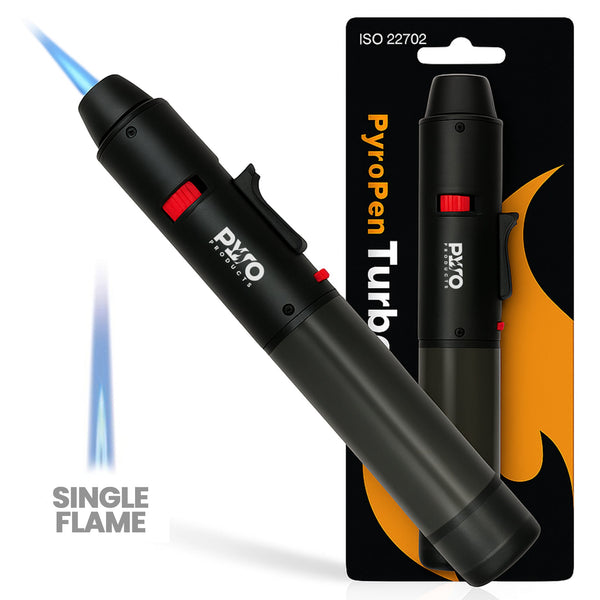
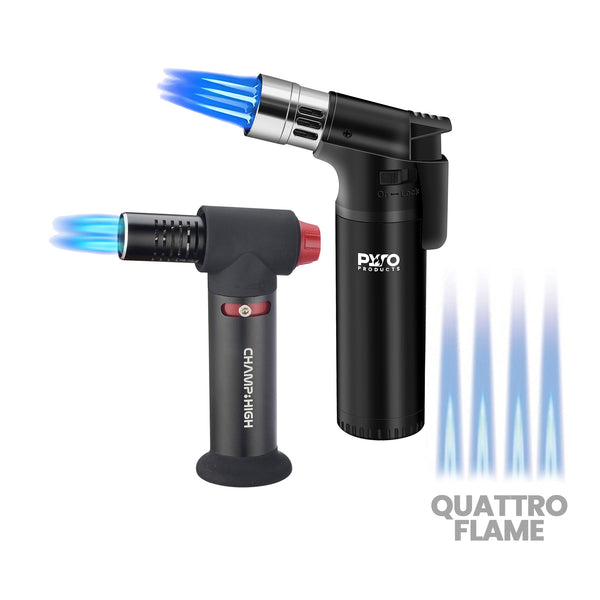
These are the five that leave our fireworks category most often. The PyroPen Turbo at 9.95 euros is our most chosen model: a long neck, refillable and cheap enough to have two at home.
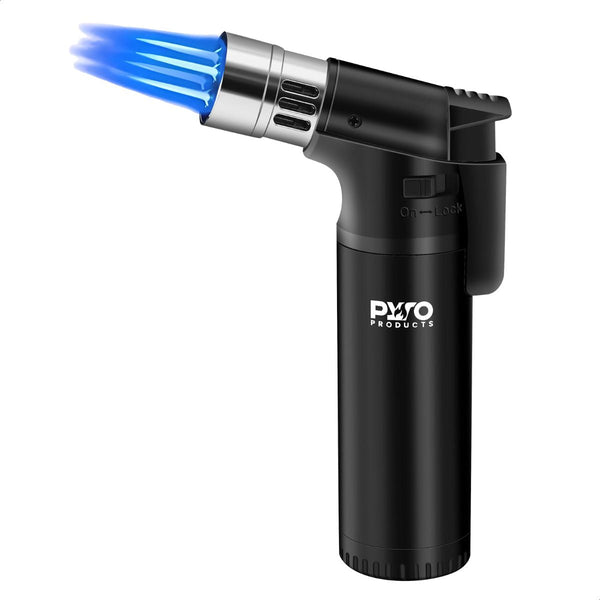
If you want a wider flame, the PyroTorch Quattro puts four jet flames side by side, with an adjustable gas supply and an on/off lock so it doesn't switch on by itself in a drawer.
The sets
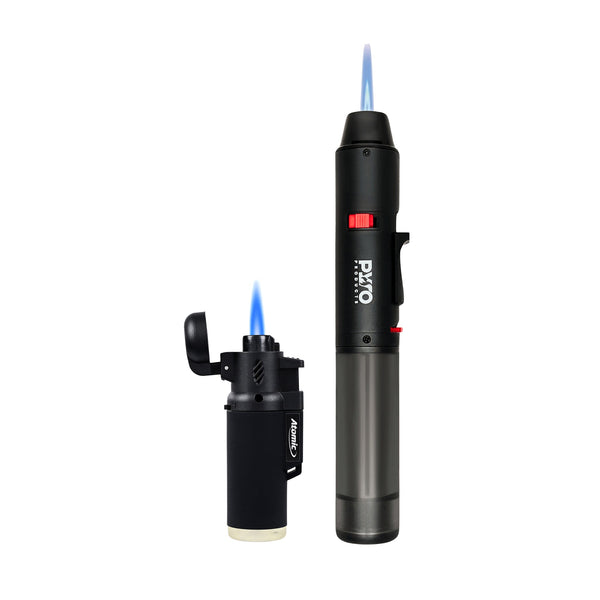
The three sets differ in what you get for your money. The Twin Lighter Set combines the PyroPen Turbo with the compact Atomic Bullet: a long one for the stove and a small one for your pocket.
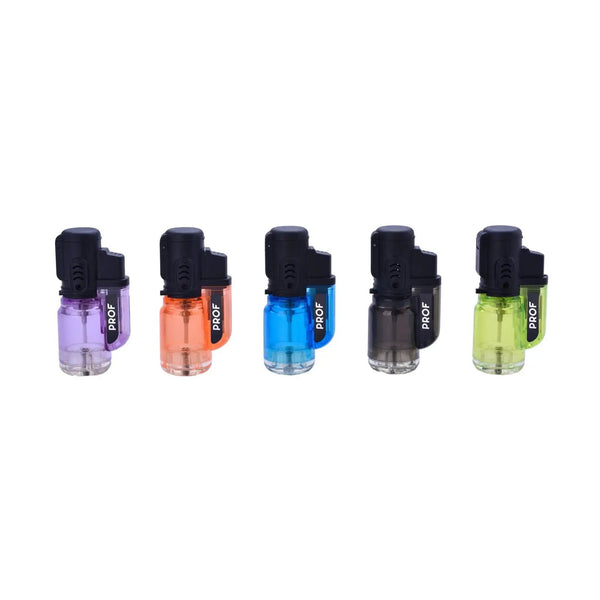
The Quattro Pro Lighter Set holds two four-flame lighters in one box, the PyroTorch Quattro and the Champ High Quattro. And the 5x Prof Jet is the cheapest route to several lighters: all five colour variants in one set, each with a hinged cap that closes off the nozzle against dirt after use.
Refilling
All five are refillable, with butane gas under high pressure. Universal lighter gas has too little pressure for a jet flame and gives a flame that keeps dropping out; which can fits which model you can see under lighter gas.
Why the ban was introduced
The official reason is the injuries and damage around New Year. But anyone who has followed the debate of recent years knows that something else tipped the balance: the violence against emergency workers.
Ambulance staff and firefighters who were pelted while doing their jobs. There's no arguing with that and we're not going to try.
Who foots the bill
What does sting is who foots the bill. That behaviour comes from a small group who can't behave, usually with heavy illegal stuff that never sat in a Dutch shop and had long been banned.
Half the country that neatly set a cake in the front garden now loses its evening over it.
We sell lighters, not fireworks, but we are enthusiasts, and as far as we're concerned a national ban remains a blunt instrument for a problem that was mainly on the enforcement side.
Not the first restriction
It isn't the first restriction, by the way. Since 1 December 2020, bangers, firecracker strings, rockets and single-shot tubes have already been banned, and during corona sales stopped completely for two New Years.
What those years showed is that a ban on paper is something different from a quiet New Year's Eve. That's not encouragement: what's banned is banned, and we're not calling on anyone to think otherwise.
Loose fuse, for example, has been under a strict ban for much longer, and nothing changes there. Exactly what is allowed there you can read in rules on visco fuse in the Netherlands.
Exemptions and displays: what councils do with them
The ban has one exception that few people know about, and it is emphatically not a show. Associations and foundations with demonstrable local ties can apply to the mayor for an exemption to set off consumer fireworks themselves during New Year's Eve: ordinary people, not a certified company.
A maximum of 200 kilos of packaged F2, with a safety plan and a site drawing, and with one or two supervisors and no more than eight igniters aged eighteen or older.
Why this route exists
This route isn't a side issue. When the Safe New Year's Eve Act went through the House of Representatives, its entry into force was tied to conditions: a working enforcement plan from police and municipalities, a worked-out general administrative order, and a compensation scheme for the fireworks industry.
The exemption for associations was the answer to the question of what would remain for those who simply enjoy it: organised, in a safe location, under supervision.
Municipalities may refuse, and do so
And that's where it pinches. The mayor may grant an exemption, but doesn't have to. It's a discretionary power, and they can pursue a zero-policy. This happens on a large scale.
Pijnacker-Nootdorp and Nuenen are not granting a single exemption this New Year's Eve, the Zeeland mayors have jointly agreed on this, and in the Dommelstroom police district, Cranendonck, Geldrop-Mierlo, Heeze-Leende, Nuenen, Son en Breugel, and Valkenswaard all chose the same. The argument is always that supervising association fireworks costs police and enforcement officers who aren't available on New Year's Eve anyway.
The site lies outside the neighbourhood
And there's a second twist, in the conditions themselves. The idea behind the exemption was that something would remain possible in the neighbourhood: the street or district setting something off together, rather than everyone doing it separately in front of their own door.
But the launch site may not be an indoor space, must be suitable and safe, accessible for emergency services, meet prescribed safety distances, and the mayor must approve the location.
What comes out of this in practice is not a residential street but a designated field, often on the edge of the built-up area. That's something different from what the scheme was intended for.
On top of that, the Dutch Association of Insurers has stated it doubts whether affordable liability insurance will become available at all. A mayor may set such insurance as a condition. If the product doesn't exist, the exemption is effectively closed in practice, even in a municipality that would want to grant it.
And then the money
And then the money. The central show is mentioned everywhere as the alternative, but it comes out of the municipal coffers. Zeewolde is asking for fifty thousand euros excluding VAT from its general reserve, for one evening. Nationally, nothing offsets this.
The VNG supported the ban on the condition that municipalities would know in advance what it would cost them and how that would be reimbursed, and that clarity never came.
Meanwhile, the licence fees for the sale and storage of fireworks disappear while supervision remains. Municipalities like De Bilt are therefore skipping the show: high costs, poor turnout.
What's left at the end of the day
What you're left with is a law that leaves room on paper but is closed almost everywhere in practice. We find that absurd.
What was put in as a counterweight to get the law passed turns out to barely exist at the first New Year's Eve, and the alternative that replaced it isn't funded nationally. So check what your municipality has decided: the differences are large and it can change from year to year.
Starting your own fireworks association?
It's possible, and the route is set out. You set up an association or foundation with demonstrable local ties and register it with the Chamber of Commerce. Then you apply to the mayor for an exemption, including a safety plan and a site drawing of the launch site.
If granted, you may set off up to 200 kilos of packaged F2 fireworks, with one or two supervisors and no more than eight igniters aged eighteen or older.
Start in good time. The application must be submitted well before New Year's Eve, and whether the mayor cooperates varies by municipality.
And in Germany and Belgium?
Germany
The question inevitably comes up, so here's the answer. In Germany, F2 fireworks are still sold as normal, but only on the last days of the year and only to over-eighteens. Setting them off is allowed there on 31 December and 1 January, and German municipalities may add local restrictions on top.
Belgium
In Belgium, new federal rules have applied since 4 July 2026, under which F1 and F2 remain available as festive fireworks. Setting them off is another story: in Flanders that has in principle been banned everywhere since the 2019 decree, unless a municipality makes an exception for a particular occasion. In Brussels the police regulations forbid it.
And in the Netherlands?
For the Netherlands that changes nothing. The ban here applies to buying, possessing and setting off, and it doesn't matter which country you got it from. Fireworks that are legal across the border are banned here the moment they cross that border.
The Human Environment and Transport Inspectorate checks for this in postal sorting centres, among other places, and seizes what it finds; it results in a fine and in serious cases community service or a prison sentence.
We don't sell fireworks ourselves and we're not pointing anyone towards the border. This is here because the question gets asked and the answer is unambiguous.
Frequently asked questions
On 1 August 2026. The New Year's turn from 2026 to 2027 is the first one it applies to. The ban is nationwide and permanent, unlike the temporary municipal bans of previous years.
Only F1 fireworks: sparklers, party poppers, snap pops and small ornamental fountains. You can buy and set those off from the age of twelve, all year round. Everything in F2 and F3, such as cakes and ground spinners, is banned for consumers from 1 August 2026.
Yes. Professional shows remain permitted, carried out by certified companies with the required safety distances. Associations and foundations with local ties can apply for an exemption to have one organised.
Setting off banned consumer fireworks costs 250 euros, 375 for a repeat offence. Possession of up to 25 kilos costs 100 euros. From 100 euros a note goes on your criminal record, which can get in the way of a certificate of conduct. Setting off illegal F3 fireworks costs 600 euros per item.
Yes, nothing changes there. A lighter isn't fireworks. You'll just use it for something else: the fire pit, the barbecue, the stove or candles. See our range of lighters.
You can apply, but getting one is a different matter. An association or foundation with local ties can request an exemption from the mayor for up to 200 kilos of F2 fireworks at a designated location. The mayor decides, and many municipalities aren't granting any exemptions this New Year.
In short
From 1 August 2026, as a consumer you may no longer buy or set off consumer fireworks. F1 remains: sparklers, party poppers, snap pops and ornamental fountains, from the age of twelve.
Professional shows go ahead and municipalities may grant exemptions, though most are choosing not to this New Year. We think it's a shame, and you'd expect that from a shop like this.
What is still allowed still has to be lit. You set a fountain down and light it from a distance, and a long lighter with a jet flame is nicer for that than a disposable: you keep your hand away from the fuse and the flame doesn't blow out. The PyroPen Turbo is the most chosen for that, but every model in the fireworks lighters does the same job.
Related articles
 Fireworks
The 10 best firework lighters
 Lighters
Jet flame lighter or soft flame: what is the difference?
 Fireplace
Top down fire: lighting your fireplace from the top
Want more articles like this?
New tips, product comparisons and exclusive offers straight to your inbox. Plus 10% off your first order.